

All-Risk Insurance Explained: What It Covers and Why You Need It
Introduction
Insurance jargon often feels like a secret language designed to keep you guessing. Between “premiums,” “deductibles,” and “riders,” it’s easy to feel like you’re reading a technical manual rather than a safety net. However, all-risk insurance is actually one of the most straightforward and essential tools in your financial toolkit. While most insurance policies tell you exactly what is covered (and leave the rest to chance), all-risk insurance turns the tables: it covers almost everything unless it’s specifically written off the list.
In this guide, we’re stripping away the complexity. We’ll look at what all-risk insurance covers, why it’s the ultimate solution for your gadgets and valuables, and how it differs from the “comprehensive” cover you might already have.
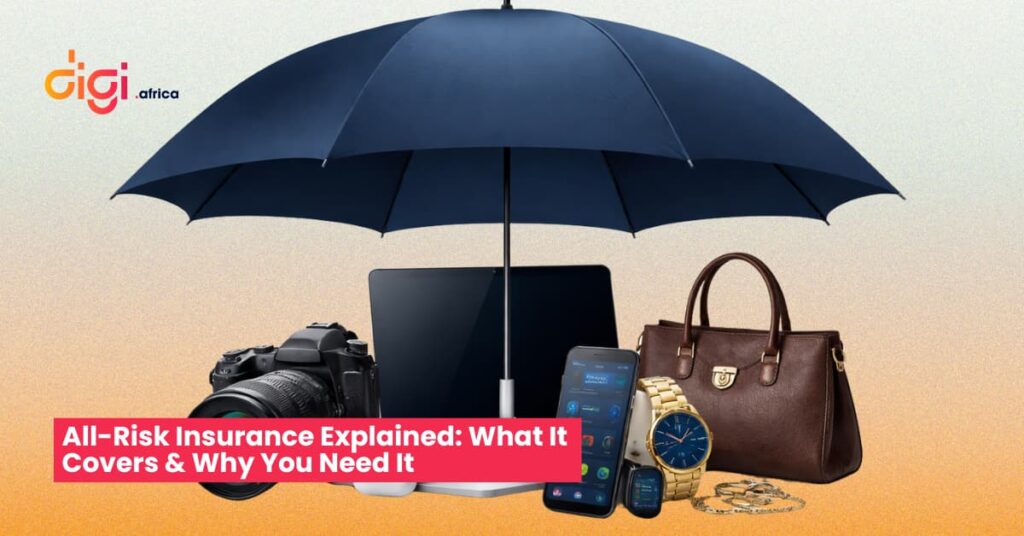
What Is All-Risk Insurance?
If you’ve ever dropped your phone on a pavement in Nairobi or had a laptop bag snatched while traveling, you know that life happens fast. All-risk insurance is designed for exactly these moments.
Unlike standard home insurance, which often only protects your belongings while they are physically inside your house, all-risk insurance follows you wherever you go. It is a policy specifically built for portable items insurance, protecting the things you carry, wear, and rely on daily.
Definition: All-risk insurance is a policy that covers accidental loss, damage, or theft of specified personal items both inside and outside the home, unless the cause of the loss is specifically excluded in the policy document.
In short: if it’s an accident and the policy doesn’t explicitly say “no,” you’re likely covered.
What Does All-Risk Insurance Cover?
The beauty of this cover lies in its breadth. It isn’t just about fire or lightning; it’s about the clumsy, unpredictable, and unfortunate events of modern life.
1. Accidental Damage
This is the most common reason for claims. We’ve all been there, a butter-fingered moment that results in:
- A cracked smartphone screen.
- A laptop that fell off a desk.
- A high-end camera lens that shattered during a shoot.
- Liquid spills on expensive electronics.
2. Theft (Including Outside the Home)
Most people don’t realize that their standard home insurance might not cover a phone stolen at a restaurant or a watch taken during a mugging. Personal all-risk insurance is designed to bridge this gap. Whether it’s pickpocketing in a crowded space or a burglary at your office, your listed items are protected.
3. Loss of Portable Valuables
Sometimes, things just… disappear. You leave your engagement ring at a gym locker, or your designer sunglasses go missing at an event. While “mysterious disappearance” has some specific rules in insurance, all-risk cover is the primary way to protect against the actual loss of insurance for valuables.
4. Worldwide Cover
Many all-risk policies in Kenya offer “Worldwide Cover.” This means if you take your MacBook to a conference in Dubai or your camera on a safari in the Mara, you are protected against the same risks you face at home. This makes it an essential gadget insurance cover for frequent travelers.
What All-Risk Insurance Does NOT Cover
Even the most robust policy has boundaries. To maintain all-risk insurance standards of transparency, it’s important to know what stays on your tab. Standard exclusions typically include:
- Wear and Tear: No insurance covers your phone getting slower or your watch strap fraying over time. This is considered maintenance, not an “accident.”
- Mechanical or Electrical Breakdown: If your laptop’s motherboard simply stops working due to a manufacturer defect, that is usually a warranty issue, not an insurance claim.
- Intentional Damage: If you break it on purpose, the policy is void.
- Unspecified Items: If you buy a new tablet but forget to tell your insurer to add it to your “All-Risk” schedule, it isn’t covered.
- War, Terrorism, or Illegal Acts: Standard in almost all insurance contracts worldwide.
Who Needs All-Risk Insurance?
If you own items that would be financially painful or impossible to replace tomorrow, you need this cover. Specifically, it’s a “must-have” for:
- Professionals on the Move: If your laptop is your office, losing it doesn’t just cost you the hardware; it costs you productivity.
- Students: Carrying laptops and tablets between hostels and lecture halls carries a high risk of theft and accidental drops.
- Frequent Travelers: Whether for business or leisure, being in unfamiliar places increases the risk of loss and theft.
- Business Owners: Protecting company-issued phones and equipment is vital for operational continuity.
- Owners of High-Value Jewelry: Engagement rings, luxury watches, and heirlooms need protection that extends beyond the four walls of your home.
All-Risk vs. Comprehensive Insurance: What’s the Difference?
In Kenya, the term “Comprehensive” is almost always associated with motor insurance. While both offer wide protection, they serve very different purposes.
| Feature | All-Risk Insurance | Comprehensive Insurance |
| Primary Target | Portable items (phones, laptops, jewelry) | Vehicles or fixed property (buildings) |
| Covers Portability | Yes (worldwide or countrywide) | Usually fixed to the vehicle/property location |
| Accidental Loss | Includes losing an item (e.g., dropping a ring) | Usually limited to damage/theft of the vehicle or property |
| Usage | Designed for personal valuables on the go | Designed for major assets |
How Much Does All-Risk Insurance Cost?
The cost of all-risk cover is surprisingly manageable. Generally, the annual premium is calculated as a small percentage (usually between 1.5% and 3%) of the total value of the items you insure.
For example, insuring a smartphone worth KSh 100,000 might cost you roughly KSh 2,000 to KSh 3,000 per year. Compare that to the KSh 100,000 it would cost to buy a new one tomorrow, and the value is clear.
Key factors in pricing:
- Item Value: Accuracy is key here. Ensure you have receipts or valuations.
- Deductibles (Excess): This is the amount you pay out of pocket when you make a claim. A higher excess usually means a lower premium.
Common Mistakes to Avoid
- Underinsuring Your Gadgets: If you insure a KSh 150,000 laptop for only KSh 80,000 to save on premiums, the insurer will apply the “average” rule, and you’ll receive significantly less than expected during a claim.
- Not Listing Items Individually: All-risk cover is usually “itemized.” If it isn’t on the list, it isn’t on the policy.
- Assuming Home Insurance is Enough: Don’t find out the hard way that your home cover stops at your front door.
- Ignoring Policy Limits: Some policies have a “single item limit.” If your watch exceeds that limit, you must declare it separately.
Final Thoughts
Insurance doesn’t have to be a headache. It should be a quiet partner that allows you to live your life, travel, and work without the constant fear of “What if?”
By choosing all-risk insurance, you’re opting for a policy that is tailored to a modern, mobile lifestyle. It ensures that the tools you rely on most are protected, whether you’re sitting in a café in Nairobi or navigating an airport halfway across the world.
Get A Cover That Fits Your Lifestyle
Protect the items you rely on every day, at home, at work, or on the move. Don’t wait for an accident to happen to realize you were exposed.
Frequently Asked Questions
Understanding all-risk insurance is the first step toward getting the right protection. Here are the answers to the most common questions our clients ask.
1. Is all-risk insurance worth it?
If you own a smartphone, laptop, or jewelry that leaves your house daily, the answer is a resounding yes. Standard home insurance in Kenya (often called a Domestic Package) usually only protects your items while they are inside your house. All-risk insurance fills that gap, ensuring that a single “bad day” in the city doesn’t result in a total financial loss.
2. Does all-risk insurance cover accidental loss?
Yes. This is the biggest differentiator. While most policies only pay out for theft or fire, all-risk covers “accidental loss.” This includes those heart-sinking moments where you realize you left your tablet in an Uber or dropped your watch while hiking. As long as the loss wasn’t intentional, you’re covered.
3. Is my phone covered outside my home?
That is exactly what this policy is for! Whether you are at the office, in a café, or even traveling abroad, your listed items are protected. Most all-risk policies include worldwide cover, meaning your gadgets are just as safe in London or Dubai as they are in Nairobi.
4. How is all-risk different from home insurance?
Think of it this way: Home Insurance is for your environment (your walls, your couch, your fridge). All-Risk Insurance is for your lifestyle (the things that move with you).
- Home Insurance: Covers named perils (like fire or theft with forced entry) at a fixed location.
- All-Risk: Covers almost any accident (unless excluded) anywhere in the world.
5. Do I need to list each item?
Yes. For all-risk cover to be valid, you must provide a “schedule of items.” This is a list that specifies the make, model, serial number, and current replacement value of each item. Insurers aren’t mind-readers; if it isn’t on the list, it isn’t on the policy!