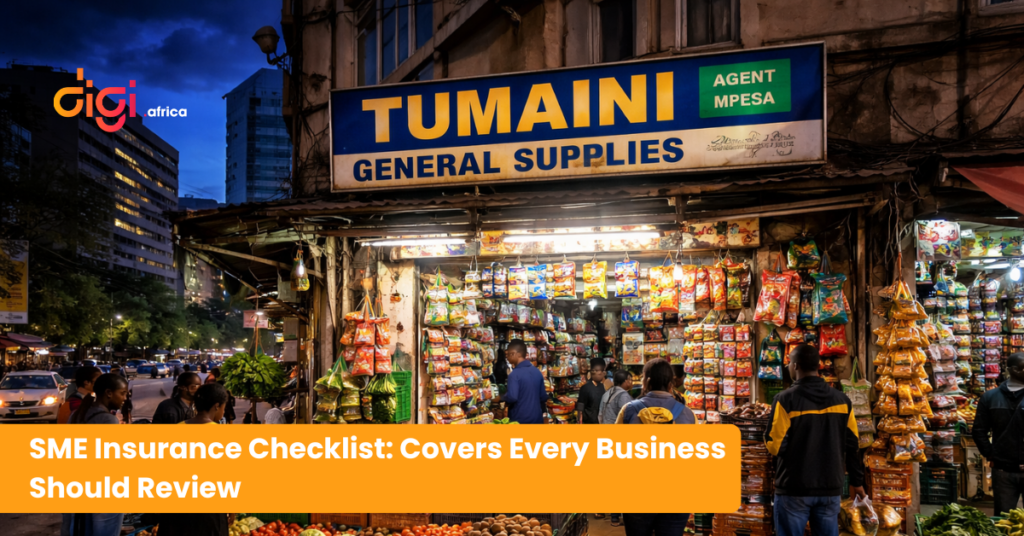
SME Insurance Checklist: Covers Every Business Should Review
Introduction
Running a business in Kenya is an exhilarating balancing act. On one hand, the digital economy is booming, cross-border trade within the East African Community (EAC) is more seamless than ever, and “Silicon Savannah” continues to attract global interest.
On the other hand, the risks have evolved. From the “Long Rains” becoming more unpredictable to the sophisticated rise of AI-driven social engineering fraud targeting M-Pesa ecosystems, the stakes for Small and Medium Enterprises (SMEs) have never been higher.
The question for an entrepreneur is no longer if something will go wrong, but whether your business is resilient enough to survive it. Financial planning without a robust insurance strategy isn’t just risky, it’s a threat to your business continuity.
This comprehensive SME insurance checklist breaks down the essential insurance covers every SME should review to stay protected, compliant, and ready for growth.
Why SMEs Need Insurance More Than Ever
If the last few years have taught us anything, it’s that “business as usual” can be disrupted in an instant. Here is why insurance has moved from a “hidden cost” to a “strategic asset” for SMEs:
- Climate-Related Risks: 2026 has seen a continuation of extreme weather patterns. Flash floods in Nairobi’s Industrial Area or droughts affecting supply chains in the agricultural sector are no longer “once-in-a-decade” events.
- The Digitization of Everything: As more SMEs adopt e-commerce and digital payment gateways, they become targets for global and local cybercriminals.
- Regulatory Compliance: The Kenyan government has tightened enforcement on mandatory covers like WIBA and Social Health Authority, making compliance a non-negotiable part of doing business.
- Economic Resilience: With fluctuating exchange rates and inflation affecting the cost of spare parts and inventory, the “out-of-pocket” cost of replacing a stolen delivery van or a fire-damaged warehouse is often enough to bankrupt a small firm.
The Essential SME Insurance Checklist
Use the following sections to audit your current coverage. Are you protected where it matters most?
1. Fire and Special Perils Insurance
This is the “foundation” of property protection. Your fire policy does much more than just cover flames.
- What it covers: Damage to your building, office furniture, machinery, and stock caused by fire, lightning, explosions, and “special perils” like floods, storms, and even riots or strikes.
- Why it matters: For an SME, your physical assets, whether it’s a boutique in Westlands or a workshop in Gikomba, represent your largest capital investment.
- 2026 Pro-Tip: Ensure your policy includes an “Inflation Guard” to account for the rising cost of rebuilding materials.
2. Business Interruption Insurance
Most business owners focus on the physical damage but forget the time lost.
- What it covers: The loss of net profit and the standing charges (like rent and salaries) that you still have to pay while your business is closed for repairs following a fire or flood.
- Why it matters: It’s not the fire that kills most businesses; it’s the three months of zero income that follow while waiting for repairs.
3. Burglary and Theft Insurance
Security technology has improved, but so have the methods used by criminals.
- What it covers: Loss of or damage to your business property following “forcible and violent” entry or exit from your premises.
- Why it matters: In urban centers like Nairobi and Mombasa, burglary remains a high-frequency risk. This cover ensures that a break-in doesn’t mean a total loss of your inventory.
4. Public Liability Insurance
Kenyan consumers are more aware of their rights than ever before.
- What it covers: Legal costs and compensation if a third party (a customer, a delivery person, or a passerby) is injured or has their property damaged while at your business premises.
- Why it matters: If a customer slips on a wet floor in your shop and sues for medical expenses and lost wages, the bill can easily reach hundreds of thousands of shillings.
5. Employers’ Liability / Work Injury Benefits (WIBA)
This is a legal requirement in Kenya under the Work Injury Benefits Act.
- What it covers: Compensation to employees for any work-related injury, illness, or death.
- Why it matters: If you have even one employee, you must have WIBA. The Ministry of Labour has increased inspections to ensure SMEs are compliant.
- Note: Many insurers now offer a “WIBA Plus” which provides higher limits than the statutory minimum.
6. Commercial Motor Insurance
If your business relies on vehicles, this is your operational lifeline.
- What it covers: Accidental damage, theft, and third-party liability for company cars, delivery vans, or motorcycles.
- Why it matters: A delivery bike accident in the CBD can halt your logistics. Comprehensive cover with an “Excess Protector” ensures you aren’t paying out-of-pocket for every minor dent.
7. Goods-in-Transit (GIT) Insurance
Essential for anyone in retail, wholesale, or distribution.
- What it covers: Loss or damage to your goods while they are being transported from a supplier to your warehouse, or from your warehouse to a customer.
- Why it matters: From road accidents to hijacking, the risks on Kenyan highways are significant. GIT protects your “money on wheels.”
8. Cyber Insurance (The New “Must-Have”)
As an SME, you likely use M-Pesa for payments and a cloud-based system for your inventory.
- What it covers: Data breaches, recovery of lost data, legal fees from privacy lawsuits, and “cyber extortion” (ransomware).
- Why it matters: Small businesses are often seen as “soft targets” because they lack the high-end security of big banks. Cyber insurance is the safety net for your digital assets.
9. Professional Indemnity (PI) Insurance
If your business provides advice or a professional service (consultants, IT firms, marketing agencies).
- What it covers: Legal costs and damages if a client claims your professional “negligence, error, or omission” caused them a financial loss.
- Why it matters: One bad piece of advice can lead to a massive lawsuit. PI is your “professional reputation” insurance.
How to Prioritize the Right SME insurance Covers for Your Business
Not every SME needs all 10 covers immediately. Prioritize based on your industry:
| Industry | Priority 1 (Mandatory/High Risk) | Priority 2 (Essential) | Priority 3 (Growth) |
| Retail/Shop | WIBA, Burglary, Fire | Public Liability | Business Interruption |
| Professional Services | WIBA, Professional Indemnity | Cyber Insurance | Group Medical |
| Logistics/Trucking | Commercial Motor, WIBA | Goods-in-Transit | Public Liability |
| Manufacturing | WIBA, Fire, Machinery Breakdown | Business Interruption | Employers Liability |
Common Mistakes SMEs Make
- Underinsuring Assets: To save on premiums, some owners declare their KSh 5M stock as KSh 2M. If you have a total loss, the insurer will only pay a fraction of the claim based on the “principle of average.”
- Ignoring Business Interruption: Many focus on fixing the building but have no cash to pay staff during the months of repairs.
- Choosing Based on Price Alone: A “cheap” policy with 50 hidden exclusions is more expensive than a quality policy when a claim actually happens.
- Not Reviewing Annually: Your business changes. If you bought new machinery in June but didn’t tell your insurer, that machinery isn’t covered.
Risk Trends SMEs Should Watch
- Social Health Authority (SHA) Transition: As the old NHIF system is fully replaced, SMEs should review how their Group Medical covers integrate with the new public system to provide the best value for employees.
- ESG Compliance: Large corporations in Kenya are increasingly requiring their SME suppliers to prove they have adequate insurance and safety protocols in place.
- Digital Fraud: “Social engineering” attacks targeting business till numbers and M-Pesa accounts are on the rise. Ensure your cyber cover is up to date on these specific local risks.
Frequently Asked Questions
- What insurance does a small business need in Kenya?
The absolute legal minimum is WIBA (if you have employees) and Third-Party Motor Insurance (if you have vehicles). However, most experts recommend a package that includes Fire, Burglary, and Public Liability as the basic “SME Shield.”
- Is business insurance mandatory in Kenya?
Only specific types are mandatory by law, such as WIBA and Third-Party Motor Insurance. However, many licenses (like those for contractors or medical practitioners) require specific covers like Professional Indemnity or Public Liability.
- How much does SME insurance cost?
For a small retail shop with KSh 1M in stock, a basic “SME Package” can cost as little as KSh 10,000 to KSh 20,000 per year. It is a small price to pay for the security of your livelihood.
- What is the most important insurance for SMEs?
Aside from the legally required WIBA, Business Interruption is arguably the most important because it ensures the business can survive a disaster, not just rebuild from one.
- How often should a business review its insurance?
At least once a year, or whenever there is a major change, such as moving to a new premises, buying new equipment, or significantly increasing your staff count.
Final Thoughts: Resilience is a Strategy
Insurance is no longer just “the cost of doing business.” It is a strategy for growth. When you are properly insured, you can take bigger risks, enter new markets, and hire more talent with the confidence that your foundation is secure.
A well-insured business is a resilient business. Don’t wait for a crisis to discover what you don’t have.
Protect Your Business Today
Don’t wait for a crisis to review your cover. Make sure your business is protected against today’s risks and tomorrow’s uncertainties.