Motor Insurance Explained: What Comprehensive Cover Really Includes
Introduction
Driving in Kenya remains a masterclass in reflexes and patience. Whether you’re navigating the multi-lane expanse of the Nairobi Expressway, dodging a rogue boda boda on a rainy evening in Kisumu, or cruising the scenic but unpredictable Mombasa Road, your car is more than just a machine, it’s a vital asset, and that’s where motor insurance comes in.
Yet, for many Kenyan motorists, “insurance” is often viewed as that annoying sticker on the windshield you buy once a year to avoid a chat with the traffic police. We tend to focus on the cost, but we rarely focus on the cover, until a matatu decides your side mirror is an optional accessory.
If you’ve ever wondered why your friend’s insurance replaced their car after a flood while yours only covers “the other guy,” this guide is for you. We’re diving into the heart of Comprehensive Motor Insurance in Kenya: what it actually covers, what it ignores, and why it’s the ultimate financial seatbelt for your lifestyle.
Motor Insurance in Kenya Explained
Before we talk about the “full package,” we need to understand the baseline. In Kenya, the Insurance Regulatory Authority (IRA) and the National Transport and Safety Authority (NTSA) mandate that every vehicle on a public road must have at least Third-Party Only (TPO) insurance.
Think of motor insurance like a tiered subscription service:
- Third-Party Only (TPO): The legal minimum. It covers damage you cause to others (their cars, their gates, their medical bills). It covers zero for your own car.
- Third Party, Fire & Theft (TPF&T): Covers the “other guy” plus your car if it catches fire or is stolen. If you crash into a wall, you’re still paying for your own repairs.
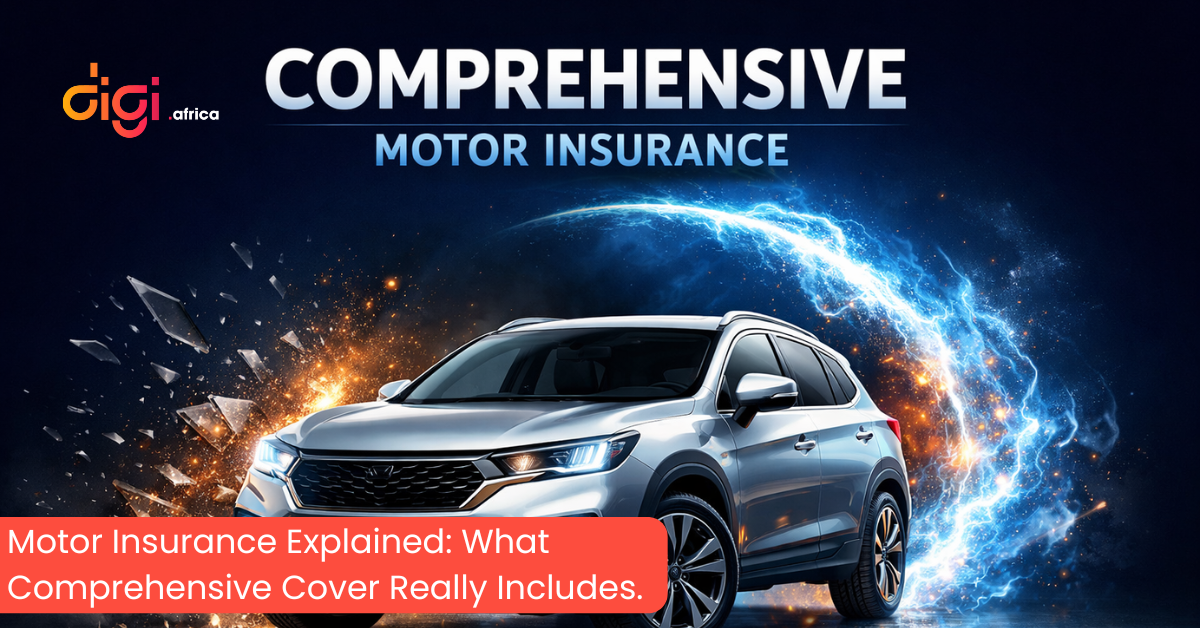
- Comprehensive Insurance: The subject of today’s deep dive. It’s the “all-in” option that protects both your liability to others and your own vehicle.
Insurance isn’t just about compliance; it’s about protecting your net worth. Where spare parts prices have risen significantly due to global supply shifts, a single accident without comprehensive cover can set your financial goals back by years.
What Is Comprehensive Motor Insurance?
In simple terms, comprehensive motor insurance is a “catch-all” policy. While TPO looks out for everyone else, Comprehensive looks out for everyone, including you.
Definition: Comprehensive motor insurance is a policy that covers accidental damage to your vehicle, theft, fire, and legal liabilities to third parties (for bodily injury, death, or property damage).
In the Kenyan context, this is the only policy that truly accounts for “The Nairobi Factor”, the reality that your car can be damaged even when you aren’t driving (think: a falling tree branch during a storm or a malicious scratch in a parking lot).
What Comprehensive Motor Insurance Typically Covers
When you sign a comprehensive policy, you aren’t just buying a “car fix” guarantee. You’re buying a bundle of specific protections.
1. Accidental Damage to Your Vehicle
This is the core reason people choose this cover. If you are involved in a collision, whether it’s your fault or not, your insurer pays for the repairs. This includes:
- Collisions with other vehicles.
- Overturning (even if no other car was involved).
- Impact damage (hitting a stationary object like a pole or a wall).
2. Damage to Third-Party Property
You’re driving and accidentally swerve into a neighbor’s expensive perimeter wall or, heaven forbid, a luxury SUV. In Kenya, the limit for Third-Party Property Damage (TPPD) in a comprehensive policy is typically capped at KSh 20 Million. This saves you from being sued into bankruptcy for someone else’s repair bills.
3. Theft and Partial Theft
Vehicle theft remains a sophisticated challenge in Kenya. Comprehensive cover compensates you if your car is stolen and not recovered.
- Total Loss: The insurer pays the “sum insured” (minus the excess).
- Partial Theft: This is crucial. If your side mirrors, wheel caps, or even your battery are plucked while you’re at a meeting, many Kenyan comprehensive policies will replace them (often under a “free limit”).
4. Fire Damage
Whether it’s an electrical fault in the wiring or a fire spreading from a nearby building, if your car goes up in smoke, your policy covers the loss.
5. Natural Perils (Acts of God)
Climate change has made “lake-sized” puddles a reality during the rainy seasons in Nairobi and Mombasa. Standard comprehensive cover protects you against:
- Floods (submerged engines).
- Earthquakes and Storms.
- Falling Objects (trees, billboards).
6. Riot, Strike, and Civil Commotion
In the event of civil unrest where your car is caught in a commotion, this benefit covers the resulting damage.
7. Personal Accident Benefits
Most comprehensive policies in Kenya provide a limited amount (often KSh 30,000 to KSh 100,000) for medical expenses for the driver and sometimes passengers following an accident. Given the shift to the Social Health Authority (SHA), having this extra “first-response” cash is vital.
Additional Optional Benefits
To truly make a policy “comprehensive,” many Kenyan drivers add “riders” or “add-ons.” These are often the difference between a smooth claim and a stressful one.
- Excess Protector: This is arguably the most important add-on. Normally, when you claim, you pay a portion (the “excess”). An excess protector (usually costing 0.25% of the vehicle value) means the insurer pays the entire repair bill.
- Political Violence and Terrorism (PVT): A standard policy often excludes terrorism or political violence. Adding this rider ensures you are covered if your car is damaged during such events.
- Courtesy Car (Loss of Use): If your car is in the garage for 10 days, the insurer provides a rental or a cash daily allowance so you aren’t stuck using matatus while paying your car loan.
- Windscreen and Entertainment Cover: Most policies give you a “free limit” (e.g., KSh 50,000). If your windshield is KSh 80,000, you can pay a small extra premium to cover the full value.
What Comprehensive Motor Insurance Does NOT Cover
Transparency is the key to a happy relationship with your insurer. You need to know where the “safety net” has holes.
- Normal Wear and Tear: If your brake pads are worn or your tires are bald, that’s maintenance, not an accident.
- Mechanical or Electrical Breakdown: If your engine simply “knocks” because you didn’t change the oil, insurance won’t fix it.
- Driving Under the Influence: If you are found to be intoxicated at the time of an accident, your claim will be rejected instantly.
- Unlicensed Drivers: If you let a friend without a valid DL drive your car and they crash, you are on your own.
- Consequential Loss: Insurance pays for the repair, but it doesn’t pay for the “depreciation” of the car’s value just because it was in an accident.
- Undisclosed Commercial Use: If you insure your car as “Private” but use it for Uber or as a delivery vehicle, the insurer will deny the claim for “misrepresentation.”
Third Party vs. Comprehensive Motor Insurance
| Feature | Third-Party Only (TPO) | Comprehensive Insurance |
| Legal Compliance | Yes | Yes (Exceeds requirement) |
| Damage to your car | No | Yes |
| Theft/Fire | No | Yes |
| Falling Trees/Floods | No | Yes |
| Windscreen/Stereo | No | Yes (Usually included) |
| Third-Party Medical | Yes | Yes |
| Best for… | Low-value, older cars (>15 years) | New cars, daily drivers, financed cars |
How Much Does Motor Insurance Cost in Kenya?
The “cost” (Premium) is usually a percentage of your car’s value.
The standard rate for a private vehicle in Kenya typically ranges between 3.5% and 5% of the car’s value per year.
Example Calculation:
If your car is valued at KSh 2,000,000:
- Basic Premium (4%): KSh 80,000
- Training Levy (0.2%): KSh 160
- Policyholder Levy (0.25%): KSh 200
- Stamp Duty: KSh 40
- Total Annual Premium: ~KSh 80,400
Factors that can lower your cost:
- No Claims Discount (NCD): If you don’t have an accident for a year, you get a discount on the next year’s premium (this can go up to 60% over several years).
- Anti-Theft Devices: Installing a tracker often leads to a premium discount.
- Low Mileage: Some “Pay-As-You-Drive” policies offer lower rates if you drive less than 5,000km a year.
Common Mistakes Motorists Make When Choosing The Right Cover
- Chasing the “Cheapest” Quote: A cheap policy often has high “excess” fees or excludes things like floods and riots. Always read the fine print.
- Under-insuring the Vehicle: If your car is worth KSh 1.5M but you insure it for KSh 1M to save on premiums, the insurer will apply “The Rule of Average” and only pay a fraction of your claim.
- Not Updating the Value: Cars depreciate. If you’ve been paying premiums on a KSh 3M value for five years, you’re overpaying. Review your valuation annually.
- Forgetting the Excess Protector: Many drivers are shocked to find they have to pay KSh 50,000 out of pocket during a claim. For a few extra shillings at the start, an excess protector removes this pain.
Final Thoughts
Motor insurance shouldn’t feel like a tax. It should feel like a partnership. In the fast-paced, sometimes chaotic environment of Kenyan roads, Comprehensive Motor Insurance is the only way to ensure that a split-second mistake, whether yours or someone else’s, doesn’t turn into a permanent financial setback.
The right policy turns a serious accident into a manageable inconvenience. It allows you to focus on getting back on the road while the insurer handles the bill.
FAQ (Frequently Asked Questions)
- Is comprehensive insurance mandatory in Kenya?
No. Third-Party Only (TPO) is mandatory by law. However, if you are financing your car through a bank, they will almost always require you to have comprehensive insurance as part of the loan agreement.
- Can I get comprehensive cover for a car older than 15 years?
It is difficult. Most Kenyan insurers restrict comprehensive cover to vehicles under 15 years old. For older cars, you may be restricted to Third-Party Only or Third Party, Fire & Theft.
- What is an “Excess” in insurance?
The “excess” is the fixed amount you pay towards a claim before the insurer pays the rest. For example, if your repair is KSh 100,000 and your excess is KSh 15,000, the insurer pays KSh 85,000. You can buy an Excess Protector add-on to avoid this cost.
- Does insurance cover my car if a tree falls on it?
Yes, under a comprehensive policy, “Acts of God” (including falling trees, floods, and earthquakes) are covered.
Get the Right Motor Insurance Cover Today
Before your next trip on the road, make sure your vehicle and your finances are properly protected.