

Flood Insurance & Parametric Covers Explained: Protecting Property During The Long Rains
Introduction
Flood Insurance is becoming an increasingly important safeguard during Kenya’s Long Rains season, the annual March–May period that plays a critical role in the country’s agricultural and ecological cycles. Yet for many property owners in Nairobi, Kisumu, and the Tana River basin, this season also brings a familiar concern: the growing risk of flooding.
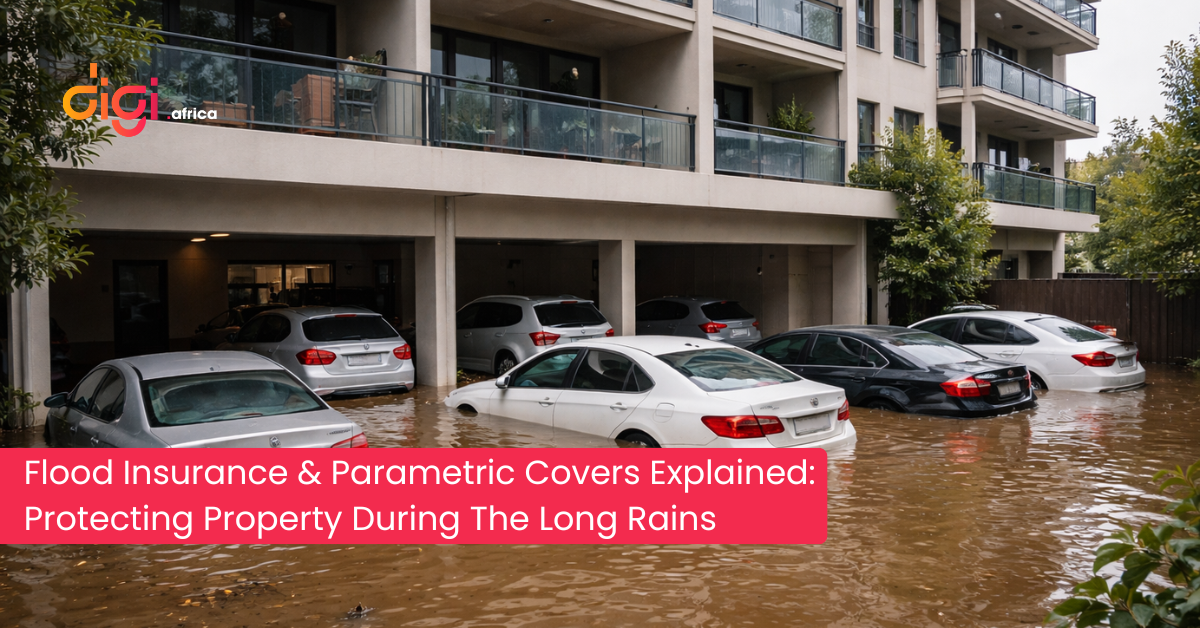
In recent years, the nature of flooding has changed significantly. Rapid urbanization, overstretched drainage infrastructure, and more unpredictable climate patterns mean that what were once minor seasonal puddles can quickly escalate into destructive flash floods. From submerged basements in Kilimani apartments, to waterlogged warehouses in Nairobi’s Industrial Area, to small farms in the Rift Valley swept away by runoff, the financial consequences of flood damage can be overwhelming.
While we cannot control the rain itself, we can rethink how we prepare for and recover from its impact. This article explores the evolution of flood insurance in Kenya, comparing traditional property protection with the emerging role of parametric insurance, an innovative solution that is transforming how individuals and businesses recover from natural disasters.
Why Flood Risks Are Increasing During Kenya’s Long Rains
The reality is that “100-year floods” are now happening every three to five years. Several factors have converged to make flood protection a top priority for Kenyan households and businesses:
- Climate Variability: Higher temperatures in the Indian Ocean are driving more intense, concentrated bursts of rainfall. Instead of steady rain over three months, we often see a month’s worth of rain falling in 48 hours.
- The Urban “Concrete Jungle”: In cities like Nairobi and Mombasa, the rapid expansion of paved surfaces means rainwater has nowhere to go. Natural “sponges” like parks and wetlands have been replaced by apartment blocks, leading to massive surface runoff that overwhelms old drainage networks.
- Infrastructure Stress: Many drainage systems were designed for a much smaller population. Blockages from plastic waste and debris often turn roads into rivers during even moderate storms.
- Property Development in Riparian Zones: Despite stricter regulations, many commercial and residential properties have been built in areas naturally prone to flooding, significantly increasing their risk profile.
The unpredictability of these events means that insurance is no longer a “maybe”, it is a mechanical necessity for anyone with a physical asset.
What Is Flood Insurance?
Contrary to what many believe, “Flood Insurance” is rarely sold as a standalone piece of paper. Instead, it is almost always a component of a larger property policy.
Flood insurance protects property owners against financial losses caused by flood-related damage to buildings, equipment, and contents. In the insurance world, a “flood” is generally defined as an overflow of water onto normally dry land, often caused by rising river levels, heavy rain, or drainage failure.
You will typically find flood protection under:
- Domestic Package (Home Insurance): Protects homeowners and tenants.
- Fire and Special Perils Insurance: The standard for commercial buildings and warehouses.
- Industrial All-Risks (IAR): A comprehensive policy for larger manufacturing and logistics firms.
What Flood Insurance Typically Covers
A robust flood policy is designed to handle three main categories of loss:
1. Damage to Buildings
If floodwaters compromise the integrity of your property, the insurance covers the cost of repairs. This includes:
- Structural repairs to foundations and walls.
- Repairing or replacing damaged electrical systems and plumbing.
- Restoration of flooring and cabinetry destroyed by water.
2. Damage to Household Contents (For Tenants and Homeowners)
Water is invasive. It destroys what it touches. A Domestic Package with flood cover will compensate you for:
- Furniture (sofas, beds, tables).
- Electronics (TVs, home theaters, sound systems).
- Kitchen appliances (fridges, washing machines, microwaves).
3. Business Property and Stock
For a business, a flood doesn’t just damage the building; it ruins the “engine” of the company.
- Inventory/Stock: If you are a retailer or wholesaler, ruined stock can put you out of business. Flood insurance pays to replace your lost inventory.
- Machinery & Office Equipment: From industrial looms to office servers and computers.
4. Business Interruption
Perhaps the most important for SMEs is Business Interruption Cover. If your shop is flooded, you can’t open for business. While repairs are happening, your bills (rent, staff salaries, loans) keep coming. This cover replaces your lost income during the period you are closed due to a flood.
What Flood Insurance May Not Cover
To manage your expectations, you must understand the exclusions. Trust is built on transparency, and most Kenyan flood insurance policies will not cover:
- Poor Maintenance: If your house flooded because you didn’t clear your own gutters or private drains for five years, the insurer may argue the damage was due to negligence, not a “special peril.”
- Gradual Seepage: Insurance is for “sudden and accidental” events. Water slowly seeping through a cracked foundation over several months is considered a maintenance issue, not a flood event.
- Uninsured Structures: Often, walls, fences, or gates aren’t covered unless specifically mentioned in the policy.
- Valuables above a Limit: If you have high-value jewelry or art, it usually needs to be “itemized” or listed separately; it won’t be fully covered under a generic contents limit.
What Is Parametric Flood Insurance?
While traditional insurance is essential, it has one major drawback: The Claims Process. After a flood, an assessor must visit your property, evaluate the damage, verify the costs, and then approve the payout. This can take weeks or even months, time you don’t have when your business is underwater.
Enter Parametric Insurance.
Definition: Parametric insurance is a type of insurance that pays out automatically when a specific “trigger” event occurs, regardless of the physical damage.
In the case of floods, the trigger isn’t a broken wall; it is a measurable data point, like total rainfall in a 24-hour period or the water level of a specific river gauge reaching a pre-agreed threshold.
How Parametric Flood Insurance Works
- The Trigger is Set: You and the insurer agree on a parameter. For example: “If it rains more than 100mm in 24 hours in Upper Hill, Nairobi.”
- Monitoring: Third-party satellite data or certified weather stations monitor the rainfall in real-time.
- Automatic Payout: If the data shows the rain hit 105mm, the “parameter” has been met. The payout is triggered automatically.
- No Assessment: You don’t need to wait for a loss adjuster to see your furniture. The money is usually in your account within days.
This is a game-changer for natural disaster insurance in Kenya, as it provides immediate liquidity to handle urgent cleanup or relocation.
Traditional vs. Parametric Insurance: Which Do You Need?
| Feature | Traditional Flood Insurance | Parametric Insurance |
| Claims Process | Requires physical assessment & proof | Automatic trigger via data |
| Payment Speed | Slower (Weeks/Months) | Very Fast (Days) |
| Trigger | Actual damage to property | Weather data (e.g., mm of rain) |
| Basis of Payout | Cost of repairs/replacement | Pre-agreed fixed amount |
| Flexibility | Covers specific items | Cash can be used for anything |
Many businesses choose a Hybrid Approach. They use traditional insurance for the “big fix” (rebuilding the warehouse) and parametric insurance for the “fast cash” (paying staff and cleaning up the mud immediately).
Who Should Consider Flood Insurance in Kenya?
- Homeowners in Flood-Prone Areas: If you live near a river, at the bottom of a hill, or in areas with known drainage issues.
- Retailers & Wholesalers: Anyone whose wealth is tied up in physical stock on the ground floor.
- Logistics Companies: Warehouses are often in industrial zones that are highly susceptible to flash floods.
- Farmers: Especially those near the Tana River or in the Rift Valley, where “Parametric Crop Insurance” is becoming the gold standard for survival.
Is it Worth It? The Cost vs. Loss Perspective
The most common objection is the premium. However, consider the math of 2026:
- Cost of a Home Insurance Policy: Approximately KSh 15,000 – KSh 25,000 per year for a standard suburban home.
- Cost of Flood Damage: Replacing a flooded living room (electronics, sofa, carpets) and repainting can easily exceed KSh 800,000.
“The right policy turns a crisis into an inconvenience.” Without insurance, a flood is a disaster. With insurance, it’s a project.
Practical Steps to Protect Your Property During the Long Rains
- Review Your Current Policy: Does it specifically include “Flood” and “Special Perils”? Check your schedule today.
- Document Everything: Take photos of your property, your inventory, and your high-value electronics before the rains get heavy. Store these photos in the cloud.
- Improve Drainage: Clear the trenches outside your gate. Ensure your home’s internal drainage isn’t blocked by leaves or debris.
- Consider Parametric Options: If you are a business owner, ask your broker or insurance provider about “Weather Index” or parametric covers for rapid liquidity.
Final Thoughts
Floods are unpredictable, but your financial recovery doesn’t have to be. As we navigate the long rains, preparation is the only variable we can control. Insurance isn’t about expecting the worst; it’s about making sure that even if the water rises, your family and your business stay afloat.
FAQ (Frequently Asked Questions)
- Does insurance cover flood damage in Kenya?
Yes, but usually as part of a larger policy like a Domestic Package (for homes) or Fire and Special Perils (for businesses). Always verify that “Flood” is listed as a covered peril.
- What is parametric flood insurance?
It is a modern insurance type that pays out based on a data trigger (like rainfall amount) rather than a physical damage assessment. It is much faster than traditional insurance.
- Is flood insurance mandatory?
No, it is optional. However, if you have a mortgage, your bank will almost always require you to have property insurance that includes flood cover.
- How long does a flood claim take?
Traditional claims can take 30 to 60 days depending on the complexity. Parametric claims are often settled in less than 7 days.
Protect Your Property Before the Next Storm
Don’t wait until the floodwaters are at your door to discover gaps in your protection. Get the right cover before the rain intensifies.