From Quotes to Claims: How WhatsApp Is Simplifying Insurance in Kenya
Introduction
A few years ago, purchasing an insurance policy or filing a claim in Kenya felt like preparing for a minor court battle. It inevitably involved wading through multi-page paper forms, scheduling physical visits to corporate offices along Upper Hill or Westlands, and enduring endless cycles of phone holds. For the average Kenyan, the process felt intentionally opaque, heavily bureaucratic, and deeply uninviting.
Today, that entire landscape is undergoing a massive shift.
Instead of dealing with thick folders and confusing industry jargon, thousands of Kenyans are managing their protection portfolios directly within an app they already open dozens of times a day: WhatsApp. From calculating a quick travel insurance estimate to reporting a minor traffic accident, WhatsApp insurance in Kenya is transitioning financial safety out of cold corporate offices and straight into a familiar chat bubble.
The Historic Barriers to Financial Protection
To understand why a simple chat app is making such massive waves, it helps to look at why insurance uptake in Kenya has historically hovered at a low percentage of gross domestic product (GDP). The issue wasn’t that individuals and small businesses didn’t face risks; it was that the path to securing coverage was riddled with friction points.
- Excessive Admin Work: Filling out lengthy physical documents just to get a baseline price estimate alienated busy professionals and small traders alike.
- The Inaccessibility Gap: Traditional brick-and-mortar brokerages concentrated their physical branches within major urban centers like Nairobi, Mombasa, and Kisumu, leaving smaller towns and rural communities underserved.
- Slow Turnaround Times: Waiting days for an underwriter to review a physical file and email back a quote meant that many people simply abandoned the process halfway through.
- A Perception Crisis: Because policies were written in dense, legalistic terms, a widespread belief emerged that coverage was designed to be deliberately confusing, harming general trust.
Why WhatsApp is the Natural Choice for Kenya’s Insurtech Boom
The rise of conversational insurance isn’t an accident, it is a logical response to how Kenya communicates. The country boasts an exceptionally high smartphone penetration rate, and within that digital ecosystem, WhatsApp is king. It crosses generational divides, connects urban tech enthusiasts with rural micro-entrepreneurs, and requires almost zero technical training.
By deploying smart automated interfaces and dedicated customer support lines over the official WhatsApp Business platform, local underwriters are meeting the market exactly where it already lives.
Deconstructing the New Digital Customer Journey
Conversational technology completely flips the traditional insurance lifecycle on its head. By turning a rigid administrative process into a rolling dialogue, insurers can break down the experience into clear, manageable milestones.
1. Instant Pricing and Customization
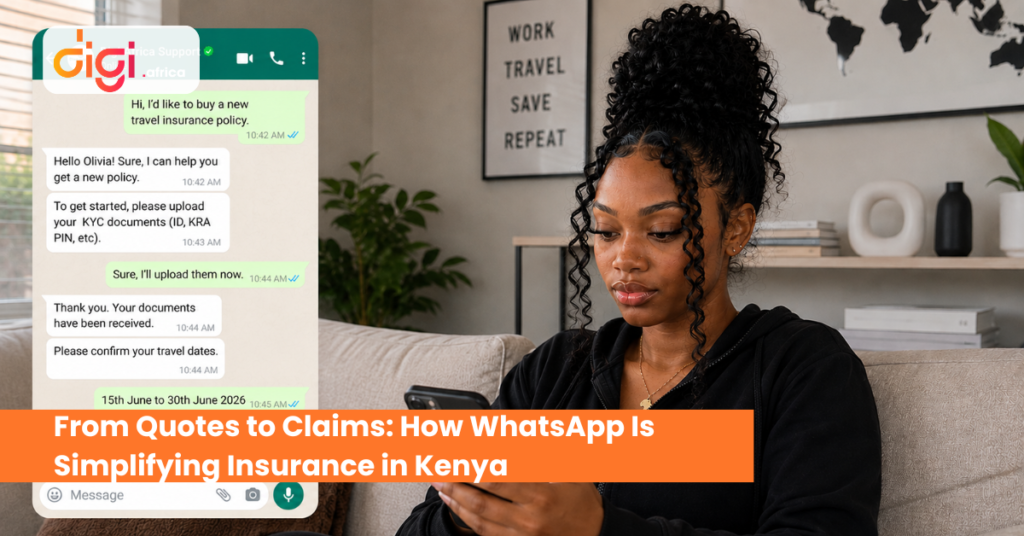
Instead of manually calculating complex depreciation scales or premiums, a consumer can text a phrase like “Hi, Motor Quote” to a verified number. An automated system immediately replies, asking a few brief questions:
- What is the car’s make?
- What year was it manufactured?
- What is its estimated valuation?
Within less than two minutes, a fully broken-down, transparent quotation lands in the chat.
2. Conversational Verification (KYC)
Once a client selects a quote, the Know Your Customer (KYC) process begins. Rather than hunting down a flatbed scanner or traveling to an office to drop off paper records, the client simply snaps clear photos of their national ID, KRA PIN certificate, and logbook using their phone’s camera and uploads them directly to the chat string.
3. Integrated Mobile Payments
The transaction concludes using a seamless integration with mobile money services. The automated system triggers an instant M-Pesa STK push notification directly to the user’s phone line. The user types their PIN, the premium clears safely, and the platform automatically generates and delivers a digital insurance certificate (such as an AKI motor sticker or an international travel cover document) as an instantly downloadable PDF right inside the conversation thread.
The Automated Renewal Cycle
The customer gets a message like the following when it is time to renew their policy.
“Hello! Your comprehensive motor insurance policy is expiring this Friday.
Your customized renewal rate is KES 14,500. To renew immediately and update
your digital certificate, simply reply with the word ‘RENEW’.”
4. Stress-Free Claims Intake
The true test of any provider happens during a crisis. If a traveler gets stuck at an international airport due to a severe delay, or if a car owner experiences a minor fender-bender on a rainy evening, they no longer have to wait until regular Monday-to-Friday business hours to log an issue.
Through the chat interface, the client can instantly pin their precise GPS coordinates, upload real-time smartphone photos of the vehicular damage or baggage receipts, and text a brief voice note explaining the situation. This instantly logs the event in the underwriter’s core system, drastically cutting down processing times and allowing the user to get assistance when they need it most.
Driving Real Financial Inclusion Across the Country
Shifting to mobile-first communication does more than just bring convenience to corporate workers in Nairobi, it actively expands access for demographics that have been historically ignored by traditional financial models.
-
Empowering the Informal Sector and SMEs
Small business owners, shopkeepers, and open-air market traders often operate on tight, unpredictable schedules. They cannot afford to lock up their businesses for half a day to visit an insurance office. A platform that lets them secure a quick personal accident cover or shop protection in between attending to customers keeps their businesses safe without disrupting their daily revenue.
-
Engaging First-Time Gen Z Buyers
Kenya’s younger demographic views traditional corporate paperwork as completely outdated. They expect financial products to feel as fast and intuitive as ordering a meal or checking social media. By offering hyper-specific, bite-sized options, like micro-cover for electronic gadgets, short-term event coverage, or specialized pet insurance, insurers can successfully build long-term relationships with a new generation of buyers.
Comparing the Approaches: Traditional vs. Mobile-First
| Feature | The Old Way | The WhatsApp Way |
| Document Submission | Physical paper forms & photocopies | Direct photo uploads & PDFs |
| Processing Time | Hours to days of manual review | Instant automated quotes & delivery |
| Availability | Strict Monday-to-Friday office hours | 24/7/365 automated access |
| Premium Payment | Bank checks, cash deposits, or office visits | Direct integrated M-Pesa STK push |
| Claims Reporting | Complex physical filing at branches | Instant media uploads & location sharing |
Smart Best Practices for Secure Digital Browsing
While interacting via chat offers unparalleled convenience, consumers must remain cautious and alert to protect their financial data from online bad actors.
Verification Matters: Always look for the official green verification badge next to the insurance provider’s name on WhatsApp. Authentic insurance brokers and corporate underwriters will never use a generic personal phone number to conduct official business or collect payments.
Furthermore, ensure that all payments are handled via official corporate paybill numbers or direct system-generated push prompts. Never send funds directly to an individual mobile number claiming to represent a company. Finally, always take the time to download and review the final PDF policy document to confirm that the specific coverage limits and excess clauses match your expectations.
The Next Frontier of Digital Insurance
What we are seeing right now is just the foundational stage of a broader digital transformation across East Africa. As conversational artificial intelligence continues to mature, the capabilities of these chat systems will expand rapidly.
We are moving toward a future where automated systems can instantly analyze damage photos using machine learning to settle micro-claims within minutes, provide highly localized weather-risk alerts to agricultural policyholders, and automatically adjust premiums based on real-time usage data. By turning insurance from a cold, distant transaction into a supportive, ongoing dialogue, technology is finally proving that protecting what matters most can be as easy as sending a message to a friend.
Frequently Asked Questions
1. Can I legally purchase a full insurance policy over WhatsApp in Kenya?
Yes. Official corporate systems are linked directly to accredited underwriters and digital systems approved by the Insurance Regulatory Authority (IRA). The digital certificates and policy documents delivered via the platform are fully valid, legal, and compliant.
2. Is it completely safe to share my personal documents on the platform?
As long as you are interacting with an official account that features the verified green checkmark, your data is handled securely. Established providers utilize encrypted enterprise programming interfaces (APIs) that route your personal data directly into secure, firewalled databases to safeguard your privacy.
3. What should I do if the automated bot cannot understand my request?
Most major conversational systems feature a built-in “human handoff” mechanism. If the automated tool encounters a complex question, an unconventional query, or a specialized claim, you can simply type “Talk to an agent” to immediately transfer the chat to a live, human customer service representative.
4. Can I use the platform to report an accident and file a claim?
Absolutely. Most modern digital systems include a dedicated claims menu option. You can upload photos of the incident, attach a copy of your police abstract, submit your precise location pin, and track the real-time review status of your claim without making a single phone call.